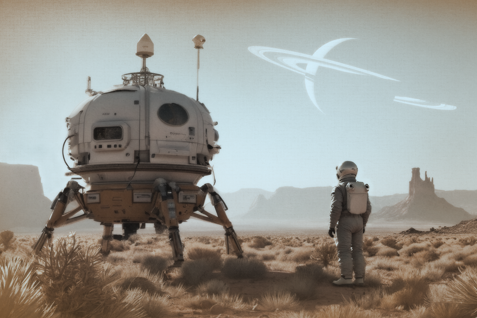
Sometimes, when one wishes to “get away from it all,” nowhere on earth will quite do.
So I recently took a little mental vacation to a little Earth-like world I’m calling Arborius.
Arborius, like Earth, is orbiting a yellow dwarf star, Lumius, which is slightly smaller than Sol. But Arborius is a little closer to Lumius, resulting in warmer climates overall, making it unlivable for a human being anywhere in the tropics, but very comfortable in the temperate zones, provided one is far enough north or south. Even the polar regions seldom see any snow.
Arborius’ tilt is a little less than Earth’s, making the seasons less extreme.
Even during the summer or winter, at either pole, Lumius never gets more than a few degrees above or below the horizon, so both polar regions are in perpetual twilight. There are forests there, but they are more sparse, due the reduced light. The temperature does, rarely but occasionally, go below freezing, or very much above freezing.
And in the comfortable temperate zones, near the polar regions, days and nights are relatively brief at any time of year, and the twilight periods are rather long.
Arborius is a little smaller than Earth, with only about 83% of Earth’s Gravity (0.83 G), which gives new meaning to “taking a load off.” If you stay for more than a few days and nights, make sure to do some exercise, preferably with weights, to prevent loss of muscle tone and bone density.
I only stayed for a few days, and was pretty active while I was there, so no worries.
The air is a bit thinner on Arborius too, due (I think) to the lower gravity. But it’s also somewhat richer in free oxygen, due to the abundant plant-life, and being less tectonically active, very little of Arborius’ land masses protrudes more than a half a mile or so above sea-level.
Arborius has no moon, which may, at least partially, account for the lack of tectonic activity. Earth is constantly being churned by the tidal forces from Luna. Arborius also has lower background radiation levels than Earth did, even before we started testing nuclear weapons, because most radioactive materials are generated by tectonic activity, then spewed out onto the surface by volcanos. Arborius has no active volcanoes, and any old inactive ones have been worn down by erosion and covered with jungle.
I don’t have data on Arborius’ planetary history, but I suspect evolution may happen more slowly there, because the reduced radiation levels would also mean fewer mutations in each generation.
Arborius’ jungles are everywhere that land protrudes above it’s one global, shallow sea, even in the tropics, where, were I to step outside, I would literally be roasted alive. The plant and animal life there should definitely qualify as extremophiles.
I parked my little space-RV on the beach, for the first couple of days, in the far north, just outside the polar zone. My ship is fully equipped, stocked with my favorite foods, plenty of water and flavored drinks, air-conditioned, and very comfortable. No “real” camping for me. I prefer to take the comforts of home with me. It also provides a layer of armor should anything big and hostile show up.
Even so, when this local one-creature welcoming comity came ashore, I decided to move inland.

I’m not sure how an animal with an exoskeleton can get this big and still support itself out of the water, even in 5/6th gravity. I suspect that it may not be fully exo or endo-skeletal, having some combination of internal and external support. But I wasn’t going to try to examine it more closely to find out.
I found the natives of the inland rainforests quite a bit more welcoming.
This monkey-like creature mostly ignored me, until it realized I had food. Then it made a sport of hanging around the periphery seeking opportunities to run in and steal some.

I would have loved to have shared a little with it, and see if we could establish raport.
But, unfortunately, as on Chilth (see my earlier post), about half of the amino acids on Arborius have the reverse chirality of ours, so eating any local meat or vegetation, or feeding any of the local wildlife on Earth-food would not be a good idea.
But, of course, as on Chilth, this also means that the chances of bringing a deadly plague, or even a mild flu, to either Earth or Arborius, from the other, are remote. Viruses and bacteria from either world would find it very difficult to prey on life of the other.
As on Earth, the trees themselves are fairly still, except where a breeze or a creature of some size moves them. But there is so much animal life among their branches, that there is almost always some movement within one’s peripheral vision. And the noise! There is a loud and constant background hum, puntuated by the occasional very loud, very shrill scream.
All this can be a little unnerving, and I kept a stunner handy, just in case, but I never encountered anything very threatening in the inland forests.
These creatures, slightly larger than a squirrel, but smaller than a typical house cat, were abundant, and seemed to spend most of their time chasing small “insects.”

I put the word “insects” in quotes, as they appear to occupy similar niches, and are similar in size and often similar in appearance to Earth’s insects, but of course, do not belong in any Earth clade. “Insects” specifically refers to a sub-clade of arthropods on earth. Whatever we call them, many of the smaller ones bite, just like the mosquitos and “no-see-ems” we know, back on Earth. I take some comfort in the thought that most of my tiny attackers were likely very sick after they bit me (those that didn’t get swatted).
I don’t know how to class this little creature. It showed up as I was packing up to leave Arborius’ and showed a great deal of curiosity about me. It was so fascinated that it practically posed for this image. It was about 6 inches long. I was tempted to call it “he,” but I have no idea how they reproduce, let alone what sex this one was or if they even have sexes.
But he’s a cute little guy, isn’t he?

I would have liked to have stayed longer, but, as always, I have things to do.
