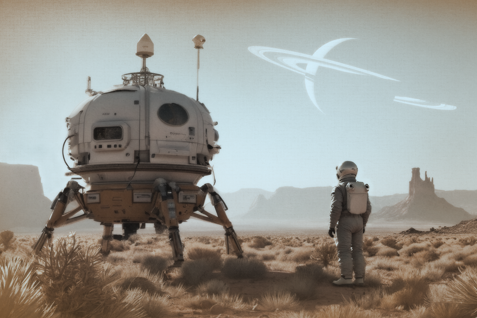

“Do you believe we are being visited by Aliens?”
Nope. The End. See you next week.
Okay, let me elaborate.
One of the things that has repeatedly flummoxed me over the years,
is the way many alien visitation proponents,
upon hearing that you don’t believe aliens are visiting Earth,
immediately launch into a fairly short but well-rehearsed speech,
about the size of the universe, the astounding numbers of galaxies, stars and planets,
and the homocentric arrogance of thinking that we’re the only intelligent life in all that.
What baffles me about this speech is being accused of arrogance,
and of not thinking the issue through,
by someone who is listing off factors I have considered,
and leaving out one of the biggest ones,
that I have, and that they apparently have not considered: Distance.
It’s a huge (astronomically huge) leap from “I believe there’s probably other intelligent life in the universe”
to “and it’s come here to Earth and is abducting people, mutilating livestock, and leaving cryptic messages in fields.”
I feel very confident that there has been, will be,
and probably is (if the word “is” can even be applied to interstellar scales)
other intelligent life elsewhere in the universe,
and probably even elsewhere in our own galaxy.
With apologies, I’m going to share with you
(fanfare)…
The Drake Equation
(feel free to skim past it if you’re not in the mood to go over it again)

where
N = the number of civilizations in the Milky Way galaxy with which communication might be possible (i.e. which are on the current past light cone);
and
R∗ = the average rate of star formation in our galaxy.
fp = the fraction of those stars that have planets.
ne = the average number of planets that can potentially support life per star that has planets.
fl = the fraction of planets that could support life that actually develop life at some point.
fi = the fraction of planets with life that go on to develop intelligent life (civilizations).
fc = the fraction of civilizations that develop a technology that releases detectable signs of their existence into space.
L = the length of time for which such civilizations release detectable signals into space.
Even though some of the James Webb Space Telescope’s recent discoveries push a couple of these numbers in a very optimistic direction, you can pitch the whole thing out, because most of these variables remain completely unknown.
A couple of them are relevant to why I don’t think ET is paying us a neighborly call, however,
specifically, how many, how long they last, and how often they emerge.
It’s not that these numbers are known or that we have any means to come up with reasonable guesses.
It’s just that even really optimistic numbers plugged into this equation don’t add up to a galaxy teaming with life, such that we would constantly be bumping into each other, trading, getting into wars with each other, etc.
It has to do with the following ubiquitous quote by Douglas Adams:
“Space is big. Really big. You just won’t believe how vastly, hugely, mind-bogglingly big it is. I mean, you may think it’s a long way down the road to the chemist, but that’s just peanuts to space.”
That’s the real issue. The vast empty spaces between all these potentially life-harboring worlds.
These distances are so great that, no matter how we try to scale our mental models, we just cannot imagine them. We simply do not function on such scales. We can do the math (not all of us, but as a species). But we just do not have any intuitive feel for such distances.
And there’s also the time to consider. Even just our own galaxy, is not only unimaginably huge on the three spatial dimensions, but also on the fourth dimension of time.
To review, the Milky Way is about 100,000 lightyears across, and more than 13 billion years old.
Even our nearest neighboring star system, Alpha Centauri, is roughly 4.2 lightyears away,
or about 24.7 trillion miles.
“you may think it’s a long way down the road to the chemist…”
And though it may seem to run counter to my stated agenda of optimistic futurism,
I suspect we may never meet ET and his friends.
Much as we might like to believe that FTL (faster than light) drives may be possible,
that we (or our alien neighbors) could warp space, bend space, slip into the adjacent hyperspace, or by some other means, circumvent or violate the cosmic speed limit, the speed of light,
so far,
we have no good reason to think we could actually do so.
There is research ongoing, but all indications are that, though a form of warp-drive might be possible in principle, the energies required would be… it’s complicated, but way more than we could reasonably expect to have at our disposal, possibly more than the entire universe could provide.
Even travelling at relativistic speeds, might bring interstellar travel to within the lifespan of an individual, at the cost of everyone you know growing old and dying long before your return.
But it is also so energy-expensive that it may just never become feasible.
But even if we assume that we, and other intelligences, do reach levels of technological development, where we can venture to neighboring star systems, even spreading out for hundreds of lightyears in all directions, over a few thousands of years.
That spread still represents only a tiny percentage of our own galaxy..
Like it or not, even the lifespan of a very successful species is finite.
We and our potential neighbors might succeed and thrive for (very optimistically) tens of millions of years. And we might spread out for hundreds of lightyears.
But that’s still a very small region and a very short time-period.
On the scale of the spacetime occupied by the Milky Way galaxy, that’s like something the size of a baseball appearing for a few seconds, at some random location, within the bounds a huge warehouse, at some random moment within a few hundred years.
Even if millions of such events happen within that span of space and time, the likelihood of two of them intersecting is pretty remote.
I suspect that, if we ever do extend our existence out into the neighboring star systems, we’re much more likely to find remnants of an ancient predecessor, than living neighbors.
Even so, If the evidence were there, I would conclude that, however unlikely it might seem, here they are.
But it isn’t. What some people accept as evidence could be a topic for a future post.
For now, I’ll just say that I have heard some good stories and some dramatic claims of evidence.
But a claim of evidence is only a claim, and one unsubstantiated claim does not substantiate another.
All that said, if we do survive our current… um… I’m going to go with “growing pains,” and survive long enough, as a species, that we travel to the neighboring stars, and still have to cope with the loneliness of being the only intelligence as far as our collective eye can see,
that would still mean we’ve survived and travelled to other stars.
It may not be all we could hope for,
But I’d say it’s a pretty optimistic vision of the future.
It would be a good problem to have.

I think aliens can be found right here: https://youtu.be/ANyJVMhOpkk?si=rzTk5mg_dug6XWXd