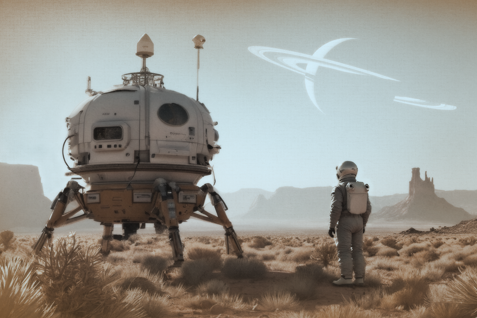

Being a fantasy prone personality, I fantasize.
Many of these fantasies take the form of excursions to other worlds.
Sometimes these other worlds are fantasy places where reality itself operates under different rules, like, for instance, a place where you can swim in the air, then just drift back to ground, as if your buoyancy were just slightly negative. There may be an actual place somewhere in our galaxy where conditions would be just right for this, but I’m not sure just what those conditions would be. (I may explore this one later)
But more often these mental excursions take me to more plausible alien worlds, some radically different from our own, some quite similar.
I love Star Wars… well, I love the original Star Wars trilogy. (let’s not open that can of worms)
I class these movies not as true sci-fi, but as space fantasy. Yep. Sorry. I am “that guy.” I’m not too hard-assed about it, but for this post, it’s relevant.
One of the things, in Star Wars movies, that I find, well… outright laughable, is planets that have one and only one defining climate.
Tatooine, a desert planet. Hoth, an ice planet. Endor, a forest moon. Dagobah, the swamp planet. That sort of thing.
There’s no suggestion of tropic or temperate zones, varying climate, humidity variations, or seasons…
Okay, seasons were mentioned by Luke’s uncle at one point. (I guess it’s easier to farm water from the air at certain times of the Tatooine year)
But generally, a desert world is a desert world, an ice world is an ice world, and so on.
So, recently I took a little mental excursion to a world I am calling Chilth.
Chilth is similar in many ways to Earth, similar size and mass, composition, and surface water, orbiting a similar solitary yellow dwarf star, called Beacon.
Chilth has one moon, Digby, roughly the same size as Luna, but in a slightly higher orbit. And Digby, has it’s own much smaller moon, Rigby. Rigby, though tiny is visible from Chilth when it’s not on Digby’s far side. Rigby looks just a little bigger than Mars or Jupiter as seen from Earth, just big enough to be seen as round, and not just a point
Unlike Earth, Chilth has no significant axial tilt, and a very circular (not eliptical) orbit, and therefore, has seasons, so the temperature ranges are relatively stable, year round, with colder polar regions, and a warmer zone around it’s equator. Digby causes tidal effects, as Luna does, here on earth, but less severe and at a slower pace, due to it’s greater distance and longer orbital period.
Chilth once was much more similar to Earth than it is now, but its orbit is expanding. It’s moving away from Beacon at a rate of about a half an inch per year, about a mile every 126,000 Earth-years. The Chilth year was about the same as Earth’s, millions of years ago, but now its year is about a third longer than Earth’s, and slowly getting even longer.
By the way, Earth is moving away from Sol, but at a decelerating rate, and should eventually start moving closer to Sol again. So, no worries… for now… about that.
Chilth’s wider orbit also makes it quite a bit colder than here. In fact, only its “tropic” equatorial zones are warm enough to support any life “as we know it.” Most water in the polar regions appears to be permanently frozen, with surface temperatures that would make an Alaskan winter look like summer in Louisiana by comparison.
The poles may harbor some interesting extremophiles. After all, “life… eh… finds a way.” But I was not equipped, on my first excursion, to visit the poles and explore that possibility.
The “tropics” are teaming with life however, in glorious variety. Sea creatures of gigantic scale swim through icey cold waters. Creatures occupying similar niches to our own orcas, seals, and even penguins, though very different in origin have evolved into relatively similar shapes. Chilth also has its own alternatives to sharks, at least one cold-water anemone-like creature and something very similar to a crab.
The big disappointment about alien life may turn out to be that it isn’t as different as we might expect, at least not on very similar worlds. Selection pressures being similar leads to similar adaptations. Form follows function. Just as our own world seams to keep making crab-shaped creatures from different lineages, so does Chilth make creatures that fit, like puzzle pieces into their own specific niches.
You wouldn’t want to dine on Chilth crabs though, even though their chemistry is very similar to life here, carbon-based, with DNA etc, and they’re not laced with poisons. But the amino acids that form proteins, here and on Chilth, have chirality, meaning they are asymmetric and either “right-handed” or “left-handed.” And about half of the amino acids on Chilth have the opposite chirality of ours, so you could eat them, and they might even taste good, but you won’t get what you need from them, and you’ll probably be up all night in the bathroom. If you visit Chilth, take ample supplies with you. Of course, this good advice for any off-world excursion.
The good news is that Chilth viruses and bacteria are very unlikely to get a foothold in your system for similar reasons. half our building blocks aren’t the ones they need so they can’t use them to make more of themselves. A Chilth Virus, invading the human body, fails to multiply, and quickly starves to death. Likewise for any Earth-virus invading Chilth’s native life.
The land is much more sparce than the sea. Landscapes vary from cold, rocky beaches to cold, rocky tundra. There are plants on the surface, but they are primarily of the hearty, slow-growing variety. If there are insects, they are rare, and probably parasites, dependent on their larger, warm-blooded hosts for heat as well as sustenance. So the plants on Chilth probably have to do without pollinators, or depend on larger animals to do it.
There are some small to medium herbivores, but they are very well camouflaged and spend most of their time hiding in cozy burrows, so I never got a good look at any. I only know of them from the few predators I encountered. Predators imply prey.
I’m including some images of the two apex predators I observed. These two species were seen on two different continents. I’m pretty sure, if their territories overlapped, they would be in direct competition. Their two, camouflage strategies, though very different, appear to work equally well, one blending with the snow-fields and the other with the rocks and grass.


The Tundra Wolf is a bit bigger than any wolf I ever saw on Earth. It and the white Tundra Lion, are similar in size, about the size of a polar bear.
I also found a swath of barren ground several meters wide, like the path of an enormous lawn-mower, with some tracks of astonishing size right down the middle of the swath. I had to make my return launch window, so I ran out of time to follow the tracks to see the creature that had made them. The prints suggest something at least the size of an apatosaur. Whatever it is, it’s size probably protects it from predators and cold alike, but the cost must be constant feeding on the tundra grasses. And those grasses grow so slowly it could take years for them to grow back. These creatures must be few in number and range quite far to get enough to eat.
I intend to visit Chilth again. I’ll try to get some more pics. Maybe next time, I’ll take some deep sea equipment along, or equip for the colder temperatures at the one of the poles.
