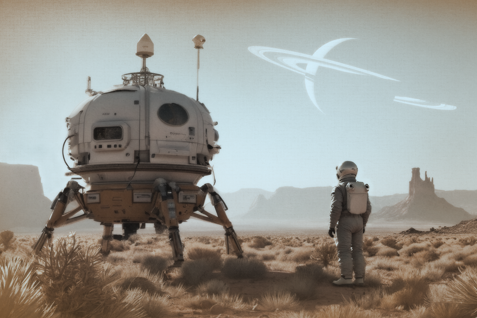
This will probably often be the case in my posts:
I recommend both the movie and the novel.
And in the case of H G Wells’ The Time Machine, I especially recommend the novel, because it’s core message has yet to survive the movie adaptation process. I’ll come back to this.
If Wells had never written the time machine, it seems to me very likely that someone else, somewhere, and probably not too much later, would have come up with a similar premise. After all, “I wish I could go back and change that” is a pretty common human phenomenon.
But I have wondered: How would that premise have differed?
Never mind the specifics of the particular future he imagined, but the time-travel premise itself.
Wells’ descriptions of the journey through time, and the mechanism used, have had an enormous effect on the time-travel stories that have followed.
I can only wonder how it might have differed, since I grew up with that influence already in place.
I also find it interesting how similar time-lapse photography done since Wells’ time seems to his descriptions of the journey. Kudos, H G. You nailed it.
So I do recommend the novel and the movie.
But which movie? Actually there are many movies based on Well’s story, or at least on his basic premise. They range from serious movie adaptations to screwball comedies, TV series episodes, and of course, porn. Time travel offers such a wide variety of environments for story-telling, from dinosaurs to the end of the universe, it’s not surprising there are so many. For obvious reasons, I will not be discussing all of them.
And yes, Hot Tub Time Machine is one of them, and yes, that is the only mention it gets in this post.


My two favorite direct movie adaptations are both simply called “The Time Machine.”
The 1960 version stars Rod Taylor, Alan Young and Yvette Mimieux.
The later 2002 version features Guy Pearce, Mark Addy, Orlando Jones, Samantha Mumba, and Jeremy Irons.
These are the two versions I recommend, though the later version differs more greatly from the novel.


There is also a version from 1978, an unsuccessful TV series pilot. This version is available on Youtube or the Internet Archive. It’s interesting, but I can’t really say I think it’s very good. Worth a look for comparison, if you’re into that sort of thing. I am, so I did. Meh.
In looking them up for this post, I also discovered that there was a version made in 1949 for the BBC. but it has not survived to the present, so my curiosity about it is an itch I can never scratch. If I have given you that itch as well, I sincerely apologize.
Ironically (and yes, I do think I’m using that word correctly),
if I had a time machine of my own, I could scratch that itch.
But one thing every movie version I have seen so far has in common is that the core message of Wells’ novel was changed.
Warning: Spoilers Ahead
In the novel, basically, a man invents a time machine, and uses it to visit the future. He could have gone to the past, but, like me, and Wells’ himself, Wells’ time traveler was more interested in the Shape of Things to Come (sorry, I couldn’t resist).
Of course, the future had some surprises in store for him. Travelling beyond the constructions and demolitions of entire cities and entire societies, into a much more distant future, the traveler finds himself in a beautiful, idyllic, and apparently engineered garden, with a perfect climate, plenty of fruits and veggies, and no biting or stinging insects, or any sign of any dangerous wildlife of any kind.
Here, the Eloi, peaceful descendants of humanity live carefree lives, sustained by the garden’s bounty. That is, until the darker nights of the new moon come, and with the darkness, come humanity’s other descendants, the subterranean Morlocks. It turns out there are predator after all. The Eloi are on the menu.
In the novel, Wells very clearly lays out the cause of this nightmare: severe and long-lasting social inequality, of exactly the kind he had witnessed in his time. Wells’ traveler, after learning of the relationship between the Eloi and Morlocks, concluded that the Morlocks had descended from the poor working class, who had been driven more and more out of sight, and ultimately underground, and denied sunlight for so long they had become averse to it.
Regarding the mild, sheeplike Eloi, he concluded, that they had descended from the rich upper class, who, in need of nothing, having had all needs met for tens of thousands of years, had lost the abilities that needs hone.
And so their roles had reversed. The descendants of the powerful had become for chattel for the descendants of their subjects.
Whether Wells’ “prediction” has any validity isn’t really the point. I doubt if he himself would have claimed to have predicted the future in any real sense. But as metaphor, even if hyperbolic, his point remains: There is a cost to everyone in an oppressive system, not just to the oppressed. The cost may not be visible or immediate, but it is there. Sooner or later the bill comes due.
This may be in poor taste, but I think of Wells’ novel every time I hear or see the phrase “Eat the Rich.”
And it always brings a smile to my face.
But even in my two favorite movie versions of this story, that message is heavily altered.
In the 1960 version, the theme is war. It’s endless war that drove the Morlocks’ ancestors underground, while technology enabled the ancestors of the Eloi to stay on the surface. The Eloi even line up and march numbly toward the entrance of the Morlocks’ underground complex, summoned by what the traveler recognizes as an air-raid horn, the habit ingrained by thousands of generations having done so to survive.
And worse, in the 2002 version, “Science goes to far,” when blasting on the moon for a new colony goes wrong, shattering the moon, causing parts of it to rain down on Earth. The destruction also shifts the orbit of the moon’s larger remnants, affecting the tides and the rhythm of life, permanently forcing some portion of the population underground.
But why? Why change it? Why not just adapt the story as it was? Well, it’s pretty obvious isn’t it?
Because Wells’ finger is pointed at the very rich, and that’s who has the money to pay for the making of a movie. Even if the producers themselves don’t directly say “I don’t like that; change it,” they don’t really have to. The entire corporate culture in which these movies are made is one in which the original message simply will not fly. You don’t promote a socialist message in Hollywood so soon after the McCarthy purges, or in 2002 either. “Don’t bite the hand that feeds you.”
This is one of the more subtle ways, that the people in charge have, of shaping public opinion. It is, in fact, so subtle that many reading this will doubt its validity, and the people doing it probably don’t even realize that they are. “I just don’t think it will sell.”
The effect this particular story has on the Overton Window or the manufacturing of consent that Herman and Chomsky described, is pretty small. But if you look again at some of your favorite movies, I think you will likely see many more examples of this influence, and many of them much larger, and many of them quite a bit more obvious.
My resolution is simply to enjoy the movies I love, while also recognizing their flaws,
and, of course to write this post.
We can hope that yet another movie adaptation will be made of The Time Machine, not by Hollywood, but perhaps by some smaller, independent film company, sticking closer to the original intent. Special effects are coming more and more within reach for us commoners, though I won’t be holding my breath.
But if not, these adulterated versions are still fun,
and we still have the novel.
If you haven’t read it, please do.
I hope you enjoy it as much as I have.
